
Trailer buying guide
Single Axle vs Tandem Axle Trailer: Which Is Right for You?
Choose by the complete loaded weight, verified trailer and tow-vehicle ratings, towing pattern, storage needs, and maintenance commitment—not by axle count alone.
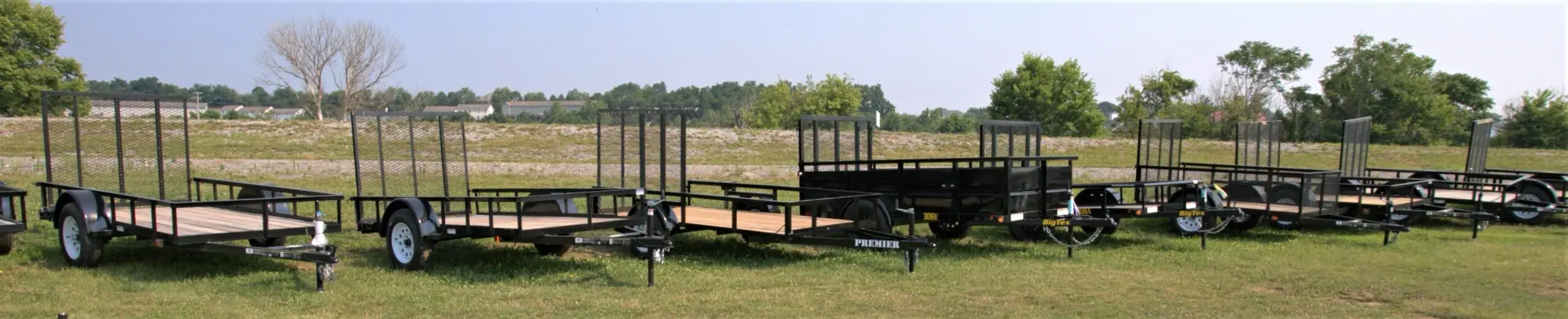
The short answer
In a single axle vs tandem axle trailer comparison, a single axle is often the simpler choice for a lighter load, compact trailer, and tight storage space. A tandem axle is often considered for a heavier or longer trailer, more frequent towing, or greater capacity. The right answer comes from the exact trailer’s ratings and your loaded use—not the number of axles by itself.
Before comparing axle configurations, calculate your expected cargo weight and choose the correct dimensions. Our guide to enclosed-trailer sizing explains how to measure the cargo, door opening, and usable interior.
What single axle and tandem axle mean
A single-axle trailer has one axle assembly. A conventional single-tire setup therefore has two tire positions and two hubs. A tandem-axle trailer has two axle assemblies located near each other, normally giving it four tire positions and four hubs.
Some catalogue systems use the label dual axle for a two-axle trailer. In this guide, tandem axle and dual axle both refer to two axle assemblies. That is different from dual wheels, where two tires are mounted side by side at one end of an axle.
Axle count is not the trailer rating
Two axle ratings should not be added and treated automatically as the trailer’s permitted loaded weight. The frame, coupler, tires, wheels, suspension, brakes, and manufacturer’s complete-vehicle rating can impose a lower limit. Check the certification label and specifications for the exact unit.
Single axle vs tandem axle: head-to-head comparison
| Factor | Single axle | Tandem axle |
|---|---|---|
| Capacity potential | Often paired with smaller, lighter trailers | Often paired with longer or higher-rated trailers |
| Empty weight | Usually lower when comparing similar bodies | Usually higher because of added running gear |
| Tight turns | Pivots without tandem tire scrub | Needs more care because tires can scrub in sharp turns |
| Hand positioning | A light, empty unit may be easier to position | Added size and weight can make hand positioning harder |
| Service points | Typically two tires, hubs, and bearing sets | Typically four tires, hubs, and bearing sets, plus more suspension parts |
| Load support | Load is supported through one axle assembly | Load is distributed through two axle assemblies |
| Best starting question | Does the exact unit comfortably carry the complete load? | Does the added capacity justify the extra empty weight and upkeep? |
These are general tendencies, not specifications. Two similarly sized trailers can have different frames, axles, tires, brakes, and gross vehicle weight ratings. Compare actual units rather than assuming every tandem is stronger than every single.
Start with loaded weight and complete ratings
Estimate the heaviest load you genuinely expect to carry. Include fuel, batteries, tools, attachments, spare parts, racks, tie-down equipment, and accessories added to the trailer. Then compare that load with the trailer’s usable payload.
Gross vehicle weight rating − empty trailer weight = payload capacity
The result is a starting maximum, not a loading target. The trailer still has to remain within its axle, tire, wheel, coupler, and other component ratings, and the load must be positioned and secured correctly. The tow vehicle must remain within its towing, payload, axle, hitch, and combined-weight limits at the same time.
A tandem configuration may offer more capacity in many product families, but the extra axle also adds empty trailer weight. That weight consumes part of the complete combination’s capacity and contributes to tongue weight carried by the tow vehicle. Use the exact published figures rather than a generic axle-count estimate. Our trailer GVWR vs payload guide explains each rating and the complete four-limit check.
Compare towing behaviour, turning, and storage
A tandem axle group has a longer contact footprint and may feel more settled over some road irregularities. That does not make it immune to sway. Loading too much weight behind the axles, insufficient tongue weight, incorrect tire pressure, excessive speed, crosswinds, worn components, or a mismatched tow vehicle can make any trailer unstable.
A shorter single-axle trailer often responds quickly while reversing and can pivot tightly. That may help in a narrow driveway, shed, or work site, but the quick response can also require small steering inputs. A longer tandem may react more gradually while backing, yet needs more space and can scrub its tires during a sharp low-speed turn because both axles cannot follow the same arc.
Think about the complete route: highway distance, rough access roads, tight gates, parking area, garage dimensions, and how often you will reposition the trailer when empty. The best configuration is the one that fits both the load and the places where it will be used.
Maintenance and ownership differences
A single axle generally has fewer running-gear components to inspect and service. A tandem normally doubles the tire positions, hubs, and wheel-bearing sets and may add equalizers or other suspension parts. If brakes are installed on more than one axle, there are also more brake components and wiring connections to maintain.
More tires do not automatically mean longer or shorter tire life. Inflation, tire rating, trailer loading, alignment, bearing condition, age, speed, storage, and road surface all affect wear. Tandem tire scrub during tight turns can create additional shoulder wear, while a heavily loaded or underinflated single-axle tire can run hot. Follow the trailer and component manufacturers’ inspection and service instructions.
- Inspect cold tire pressure, tread, sidewalls, and wheel fasteners.
- Check bearings, seals, suspension parts, wiring, lights, coupler, chains, and breakaway equipment where fitted.
- Investigate uneven tire wear rather than treating replacement as the complete fix.
- Budget for the number of tires and serviceable components on the exact trailer.
Brakes and Canadian towing checks
Axle count alone does not tell you whether a trailer has brakes or what equipment is legally required. Alberta states that a trailer with a gross weight above 910 kg must have its own brakes. It also advises using a hitch and safety chains appropriate for the trailer. Check the current Alberta RV and travel trailer guidance before towing in the province.
Rules and equipment requirements can differ by jurisdiction and trailer class. Confirm the requirements everywhere the trailer will operate, inspect the exact braking configuration, and make sure the tow vehicle has any required controller or connection. Transport Canada publishes information about vehicle safety standards, while provincial or territorial authorities govern many road-use requirements.
This guide provides general buying information, not legal or engineering advice. Manufacturer ratings and current rules for the applicable jurisdiction control.
What axle configurations appear in our catalogue?
We reviewed all 343 listings in our catalogue on September 27, 2026. The product data labels 84 trailers as single axle, 258 as dual axle, and one without axle information. Among the 96 enclosed-trailer listings, 30 are labelled single axle and 66 dual axle.
This is a dated catalogue snapshot, not a claim about current availability or proof that one configuration is better. It does show why buyers need to compare both options across real inventory. Browse the current trailer inventory, then verify the axle count, ratings, brakes, tires, condition, and availability on the exact listing with staff.
Five questions to choose the right axle configuration
- What is the heaviest complete load? Include everything carried or permanently added.
- Which exact trailer safely carries it? Compare payload and every applicable component rating, not just axle ratings.
- Can the tow vehicle handle the loaded combination? Verify towing, payload, axle, hitch, tongue-weight, and combined-weight limits.
- Where and how often will you tow? Consider distance, roads, turning space, storage, and frequency.
- Will you maintain the added components? Account for all tires, hubs, bearings, brakes, and suspension parts.
If a correctly rated single axle handles the real load with appropriate capacity and fits your towing pattern, it may be the simpler choice. If the required trailer body and load call for a higher-rated, longer platform, a tandem may be the appropriate starting point. Confirm the exact unit either way.
Common axle-selection mistakes
- Adding axle ratings and stopping there: another component or the complete trailer rating may be lower.
- Shopping from the empty trailer: ratings must work after cargo and accessories are loaded.
- Assuming tandem prevents sway: correct loading, tire condition, speed, and tow-vehicle compatibility remain essential.
- Ignoring added empty weight: the second axle and its hardware count toward the loaded combination.
- Choosing by trailer length alone: similar body sizes can be built with different ratings and configurations.
- Forgetting the ownership work: every tire, hub, bearing, brake, and suspension component requires inspection and eventual service.
Single and tandem axle questions
Is a tandem axle trailer always safer?
No axle count is automatically safe. A tandem may provide a larger contact footprint and additional capacity in a properly designed trailer, but safety still depends on correct ratings, loading, securement, tires, brakes, maintenance, speed, hitch setup, and tow-vehicle compatibility.
Does a tandem axle trailer carry twice as much?
Not necessarily. Two axle ratings do not by themselves establish the trailer’s GVWR. The manufacturer rates the complete trailer, and the frame, coupler, suspension, tires, wheels, brakes, or another component can set a lower limit.
Is a single axle easier to reverse?
A short single-axle trailer can pivot tightly and may fit small spaces, but it can also react quickly to steering input. A longer tandem may respond more gradually but needs more turning room. Practice in a clear area before entering a confined space.
Do tandem axle trailers need more maintenance?
They generally have more components: commonly four tires, hubs, and bearing sets instead of two, plus added suspension parts and potentially more brake assemblies. The actual schedule and cost depend on the exact equipment, use, condition, and manufacturer instructions.
Can my SUV or pickup tow a tandem axle trailer?
Possibly, but axle count does not answer the question. Check the specific vehicle’s towing, payload, axle, hitch, tongue-weight, and combined-weight ratings against the trailer’s actual loaded weight. The lowest applicable rating controls.