
Enclosed trailer guide
What Size Enclosed Trailer Do I Need?
Choose the smallest trailer that fits your cargo through the door, carries its loaded weight within the trailer’s ratings, and stays within every limit for your tow vehicle and hitch—with sensible room for loading and future needs.
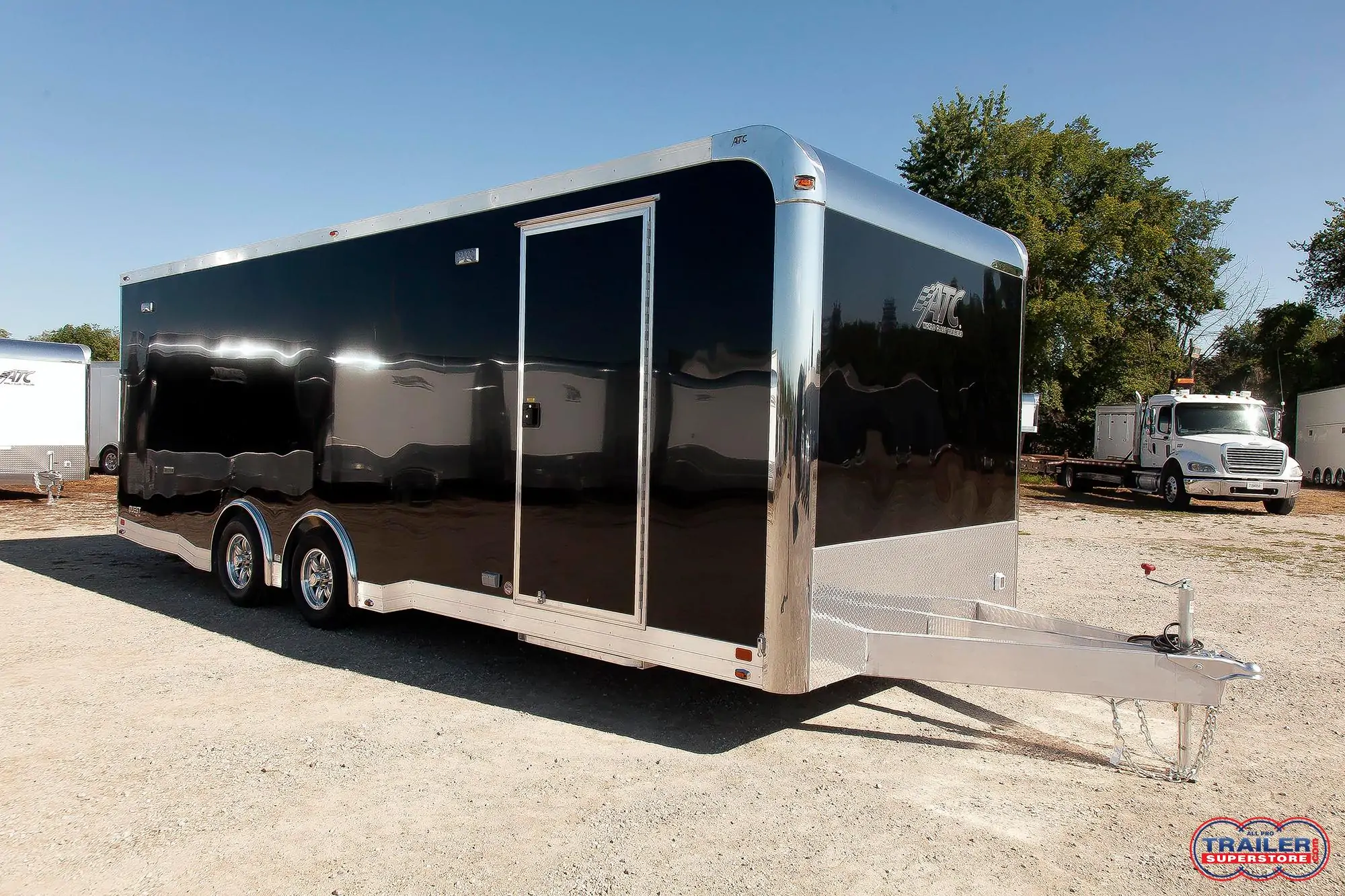
The short answer
For many buyers, the right size is found with four checks: the cargo’s outside dimensions, the trailer’s actual door opening, the loaded cargo weight compared with payload capacity, and the tow vehicle’s approved ratings. A nominal size such as 6 × 12 ft describes a general trailer class; it does not guarantee the exact usable interior, door clearance, payload, or compatibility with your vehicle.
Start by measuring what you will carry and how you will load it. Then compare those figures with the specifications on each exact unit. If you already know your minimum requirements, you can compare enclosed trailers or browse the full current inventory.
Measure your cargo before choosing a trailer
Do not begin with the trailer label. Begin with the largest complete load you expect to carry. Measure its maximum length, width, and height, including handles, mirrors, attachments, packaging, racks, or other parts that stick out. Measure with the cargo arranged as it will travel, not folded or repositioned in a way that will be impractical at loading time.
- Measure the cargo envelope. Record the longest, widest, and tallest points of the loaded arrangement.
- Plan the loading path. Decide whether cargo will enter through a rear ramp, rear barn doors, or a side door. The narrowest point on that path controls whether it can enter.
- Add working clearance. Leave room for hands, tie-downs, wheel chocks, protective padding, and safe access. A mathematically exact fit is usually not a workable fit.
- Estimate the complete loaded weight. Include cargo, tools, fuel, batteries, racks, spare parts, and anything installed after purchase.
Measure the door, not just the box
The rear or side door opening can be smaller than the interior. Ramp angle, wheel wells, roof bows, and interior trim can also reduce usable space. Ask for the exact door-opening and interior measurements of the specific trailer before deciding it fits.
Common enclosed-trailer sizes and where to start
The table below is a comparison tool, not a fit guarantee. Listed dimensions are nominal size categories. Construction, axle configuration, interior height, wall thickness, nose shape, and door design vary by model and unit.
| Nominal size | A practical starting point for | Questions to answer |
|---|---|---|
| 5 × 8 ft | Compact loads, a limited set of tools, or smaller household items | Will every item clear the door, and is the payload sufficient? |
| 6 × 12 ft | More floor space for equipment, renovation supplies, or organized work gear | Can you walk around the load and reach the tie-downs? |
| 7 × 16 ft | Longer equipment layouts or loads that need more working space | Does the combined load require a tandem-axle configuration and higher tow capacity? |
| 8.5 × 20–24 ft | Large-volume cargo or layouts where width and length are both important | Are the loaded weight, hitch, brake equipment, and tow-vehicle ratings all compatible? |
A larger trailer gives you room, but it also adds empty weight, wind area, storage demands, and manoeuvring considerations. Choose extra space deliberately rather than assuming the largest available trailer is automatically the best choice.
Physical fit is not the same as payload capacity
A load can fit inside a trailer and still be too heavy. Payload is the weight available for cargo after accounting for the trailer itself. Alberta’s towing guide expresses the basic relationship this way:
Gross vehicle weight rating − net trailer weight = payload capacity
Use the verified ratings for the exact trailer; do not estimate from size alone. Added shelving, spare tires, batteries, equipment, and accessories consume payload too. Keep the load balanced and within the trailer’s gross vehicle weight rating and axle ratings. The tow vehicle must also remain within its own limits when the trailer is loaded.
For definitions and safe-loading context, see Alberta’s Recreational Vehicle Towing Guide (PDF).
Check your tow vehicle and hitch
The trailer must suit the tow vehicle, not only the cargo. Read the tow vehicle owner’s manual and the manufacturer’s ratings for the specific vehicle configuration. Confirm the permitted trailer weight, gross combined weight, axle ratings, hitch rating, and any requirements for weight distribution or braking equipment. The lowest applicable limit controls.
Hitch or tongue weight transfers load to the tow vehicle, affecting its available payload and axle loads. Passengers, cargo in the tow vehicle, fuel, and accessories also count. If any rating or setup is unclear, obtain qualified advice before towing.
Alberta advises using a hitch and safety chains appropriate for the trailer and states that a trailer with a gross weight above 910 kg must have its own brakes. Review the province’s current RV and travel trailer guidance and applicable Transport Canada vehicle safety standards. Requirements can depend on the equipment and jurisdiction, so verify what applies to your setup.
Single axle or tandem axle?
Axle count is not a shortcut for capacity: use the ratings on the specific unit. As a general comparison, a single-axle trailer may suit lighter, more compact loads and can be easier to position in limited space. A tandem-axle design is often considered when the trailer is larger or the load is heavier, but it can add empty weight, tire and maintenance costs, and turning scrub.
Compare axle ratings, the complete trailer rating, empty weight, braking equipment, tire ratings, and your expected loaded weight together. Never select an axle setup from nominal dimensions alone. For a deeper comparison, read our single axle vs tandem axle trailer guide.
What sizes appear in our current catalogue?
As a useful market snapshot, we reviewed the 96 enclosed-trailer listings in our catalogue on September 27, 2026. The most frequently listed nominal sizes were 7 × 16 ft (19 listings), 6 × 12 ft (13), 8.5 × 24 ft (11), and 5 × 8 ft (9). That does not mean those sizes are available now or right for your load; inventory changes, and one listing did not provide dimensions.
Use this snapshot to understand the range worth comparing, then check the live enclosed-trailer inventory. Confirm availability, measurements, weight ratings, door configuration, and condition with staff for the exact unit.
Common enclosed-trailer sizing mistakes
- Buying from the nominal size alone: exact interiors and openings can differ.
- Measuring the cargo but not its loading path: an item can fit inside but fail to clear the door or ramp transition.
- Using floor area as a weight rating: volume and payload are separate limits.
- Ignoring installed equipment: shelving, batteries, spare tires, and tools reduce available payload.
- Checking towing capacity but not vehicle payload: tongue weight and vehicle cargo also matter.
- Leaving no working room: tie-downs and safe access require space around the cargo.
- Planning only for today: if your load is likely to grow, compare the next practical size before buying.
Your enclosed-trailer sizing checklist
- I recorded the maximum cargo length, width, height, and complete loaded weight.
- I know whether I need a ramp, barn doors, or a side-door loading path.
- I verified the exact interior and door-opening dimensions for the unit.
- I allowed working room for loading, tie-downs, protection, and access.
- I included installed accessories and equipment in the payload calculation.
- I checked the trailer’s GVWR, axle ratings, tire ratings, and empty weight.
- I checked the tow vehicle, hitch, axle, and combined-weight limits.
- I verified braking and safety-equipment requirements for the planned setup.
- I considered storage space and the routes where the trailer will be used.
Enclosed-trailer size questions
Is a 5 × 8 enclosed trailer big enough?
It can be a practical compact choice when the complete load clears the actual door and interior and remains within payload and towing limits. Measure your arranged cargo and compare it with the exact unit rather than relying on the 5 × 8 label.
What can fit in a 6 × 12 enclosed trailer?
That depends on the precise interior, door opening, wheel-well placement, and cargo shape. A 6 × 12 category provides more floor space than compact sizes, but only exact measurements can confirm whether your equipment will fit.
Should I buy a larger trailer than I need today?
Some reserve space can be useful for access and future cargo, but unnecessary size adds weight, wind area, storage needs, and manoeuvring demands. Compare the next size up against your actual tow and storage constraints.
Does trailer size tell me the payload?
No. Trailers with similar dimensions can have different empty weights, axle configurations, and ratings. Calculate available payload from the verified GVWR and net weight of the exact trailer, then account for installed equipment.
Can staff confirm whether my cargo will fit?
Provide the cargo dimensions, expected loaded weight, loading method, and tow-vehicle details when you contact sales. Staff can confirm the published unit details, but the buyer remains responsible for verifying cargo measurements and vehicle-manufacturer limits.